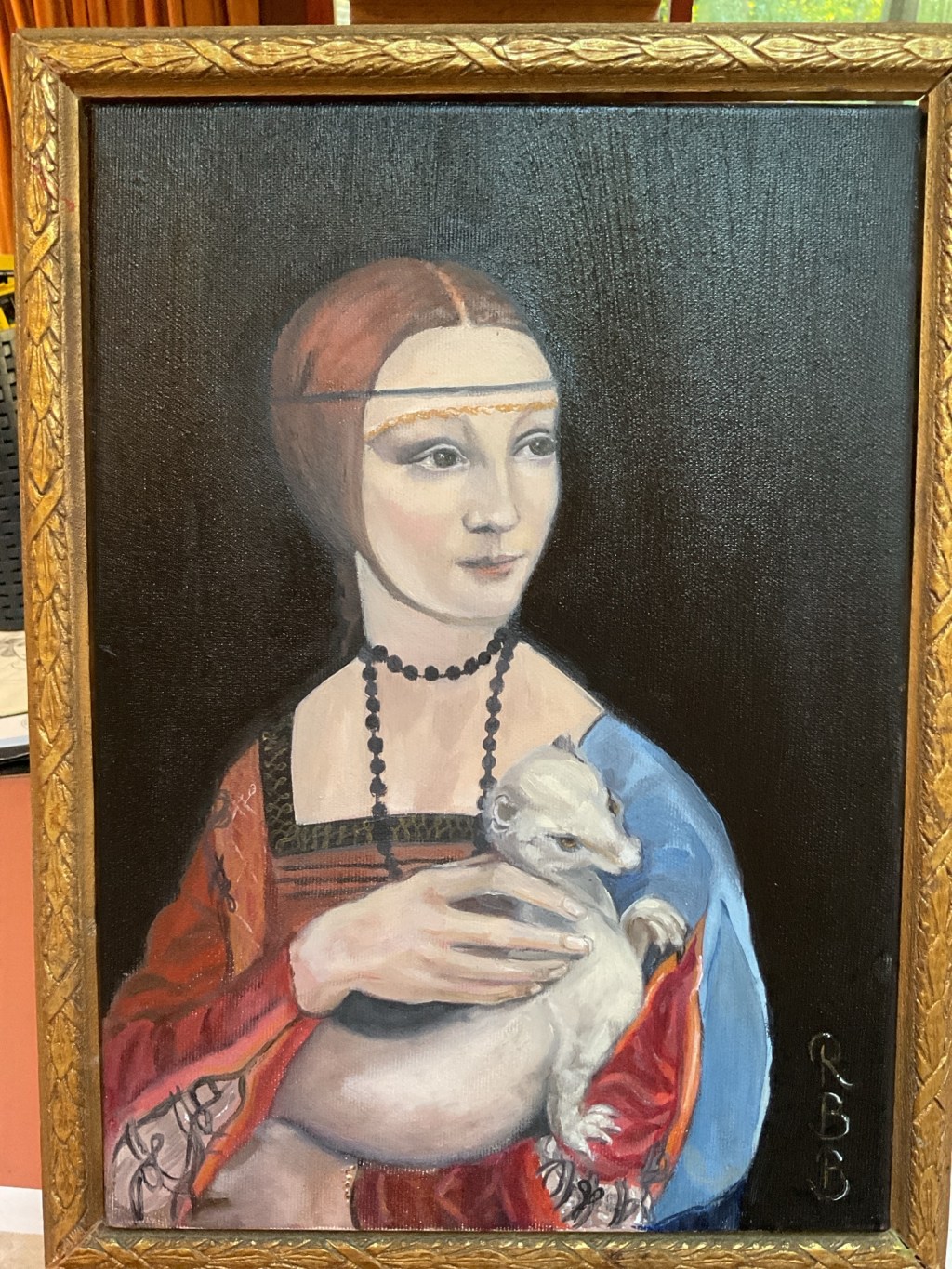
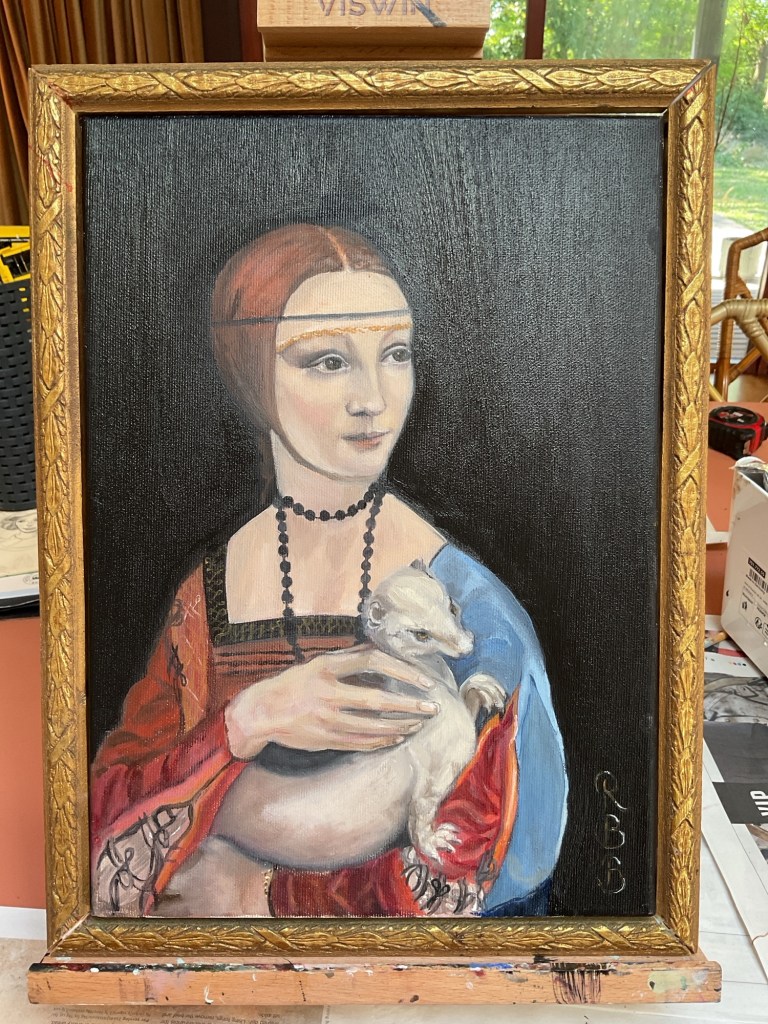
My copy ( oil on canvas) of Leonardo Da Vinci’s “Lady with an Ermine”
What do you see when you look at this painting? A beautiful young chaste noble woman caring for a pet?
It’s so much more than what meets the eye. This work contains symbolisms shrouded in double meanings to obscure the truth that can not be told in an obvious way.
My copy (oil on canvas) of Leonardo Da Vinci’s “Lady with an Ermine”
What do you see when you look at this painting? A beautiful young chaste noble woman caring for a pet?
It’s so much more than that. This work contains symbols shrouded in double meanings to obscure the truth that can not be told in an obvious way.
There are many opinions on its meaning so after studying it in great detail and painting it for the best part of a month this is what I’ve learnt and believe about this work of art. (His not mine!)
Many of us are fascinated by the stories of Leonardo da Vinci. The great luminary and polymath of 15th & 16th century Italy. Watching a documentary on him recently inspired me to paint one of his works of art . It’s a perfect way for me to pick up new techniques and to understand a work of art more fully. It also hones my observance of details that could be easily missed by just looking for a few minutes then moving on to view another painting. It took me a solid three weeks to paint it and at times a lot of frustration mixed with loads of enjoyment. As well as helping my painting practice the painting invited me to learn more about Da Vinci, about the subject herself and an insight into the ways of 15th and 16th century Italy and how it may have been for her living in such a culture.
In my art workshops I encourage my class to copy artists they love as part of their education. Learning from the masters may be a daunting prospect but there’s nothing to lose and everything to gain. It’s more about the process than coming anywhere near to their level of skill.
So back to the painting, it is one of only four portraits of women painted by this master. The Mona Lisa being the most famous and yet for me it is a more enjoyable painting to study, it is rich in both colour form and symbolism. It has always been my personal favourite, despite knowing nothing about its content.
If we look at the original, we may spend time impressed by the technical ability shown, the beauty of the subject, the pleasing aesthetic but if we really look, there’s a whole story encrypted in the pigments through a code of symbolism. So what is the story. Accounts from the day inform historians that this seemingly chaste and virtuous sixteen year old woman was apparently pregnant with her noble lover’s child and yet betrothed in marriage to another lesser nobleman. First impressions don’t tell the whole story.
Cecilia Gallerani was born in 1473 into a large family from sienna. Her father was not a member of the nobility but an ambassador to the Republic of Florence and Lucca. Her mother the daughter of a doctor of law. Cecilia was well educated alongside her brothers. At the age of 10 she was betrothed to Stefano Vacanti but the marriage was annulled without documented reason and at the age of 16 she left home for the monastery Nuevo where it is supposed she met the Duke of Milan, Ludovico Cesar also known as “Il Morro”. Cecilia became his favourite mistress but not being of noble blood she was never in line to marry him. The Duchess Beatrice, the daughter of another Duke had been betrothed to him since she was a child.
Beatrice was dismayed to discover that the affair was continuing after her marriage to Duke Sforza and insisted that Cecilia and and Sforza’s illegitimate son, Cesar be removed from Castle Sforza where all four of them resided. The Duke purportedly obeyed his new wife’s demands and arranged a marriage between Cecilia and the son of another Duke, who she went on to have five children with. Duke Sforza gave the couple a palace as their wedding gift and arranged senior church appointments for his illegitimate son by Cecilia.
The timing of the painting is disputed by scholars but one school of thought believes that it was painted whilst Cecilia was pregnant or while her son and she were living at Castle SForza. The Duke commissioned Leonardo da Vinci to paint Cecilia‘s portrait and naturally the lovers could not be painted together and so it is believed that da Vinci found a way of doing so without being explicitly offensive to Beatrice or society at large.
The Ermine was a symbol of various ideas and so this painting is always open to interpretation but as I painted and looked in detail at the work I became more and more convinced that it was in fact a painting of an illicit affair and love between two people who society dictated could never wed. Leonardo had painted the ermine many times as a symbol of purity. In Summer the Ermine Sheds its brown coat (more often referred to as a stoat in this season) which turns to pristine white and it is said that rather than Sully it’s coat it would give itself up to the poacher hence it’s it’s symbolism for purity and chasteness however it has other associations, the Greek word for Ermine is Gale which has a similar root to Gallerani, for this reason some suppose it’s an innocent play on the closeness of the two words, perhaps it’s is a double meaning but I prefer the account that informs us that Duke Sforza often use the Ermine to symbolise himself. It also a recognised symbol of nobility as we understand that the white ermine with black dotted fur worn around the shoulders of royalty even today is a tradition going way back. Every black dot in the white fur is sadly the tail tip of one ermine. So undoubtedly we can see the Ermine as a symbol of nobility and not a great leap in this case to imagine that it represents Sforza himself. When we consider this suddenly her cute pet can begin to look like a strong, muscular, beastial being. We see his taloned claw pulling back the Cecilia’s blue sleeve, a colour synonymous with the Virgin Mary to reveal a silken red vulvic-shaped vent in the Cecilia’s dress. On closer inspection we notice luxurious silks restrained by black ribbon ties, we see Cecilia’s porcelain white skin contrasted with a jet black beaded necklace, an ebony background suggesting the subject to be not as virtuous as we might at first think, purity overlaid by darkness. Come on, Is it only me 😅
So that’s the back story now let’s take a look at the imagery in the work and further understand what may have been the reason for the composition.
Her eyes are not interested in us. She only has eyes for a figure not featured in the painting but standing slightly behind her to her left, her lips belie a wry smile. The eyes of the Ermine are looking at the same subject. We can imagine that this is the Duke, Da Vinci’s patron and commissioner of the portrait. Perhaps if Cecilia is to leave his home and is betrothed to another he will at least have this painting of their union to console himself with and a proclamation that she once belonged to him.
On her left wrist, you would need to strain your eyes to see a tiny gold bracelet. Could this have been a gift from the Duke? The Ermine sits phallic like in her caressing hands he could have of course been curled up supine in her arms but interestingly a more powerful pose is chosen for the animal. No doubt this is not a living creature as it would have been virtually impossible for the sitter to remain posed with an animal of such tooth and claw.
So what can we know of Cecilia’s life? Despite being betrothed at the age of five and then becoming the mistress and Mother to the illegitimate child of a married man we can wonder if perhaps Cecilia did in fact have a loving relationship with the Duke. We know that he cared for her and his son enough to bestow financial security and even a husband of noblety upon Cecilia. There is no sign that she was in any way swept under a carpet! We learn that she was indulged in her passion for art and culture while living with the Duke and after. She was known to have arranged the first noted salon which attracted many luminaries and lovers of all things cultural. She would have been undoubtedly respected and revered for her knowledge and pursuit of the arts. So this is not entirely a story of the subjugation of a woman. Within the terrible constraints of a patriarchal and elitist society we can see that Cecilia managed to indulge her very real love of the arts and learning and in my opinion that makes her very relevant to women all around the world today. A hero against the odds who survived and lived seemingly well despite the challenges presented to her as a young woman living in 15th century Italy.
Come to a workshop where we can learn more together about Da Vinci by painting your own copy. Beginners welcome. You’ll be amazed what you can achieve with guidance.


Leave a comment