This weekend my son joined me in the studio as he wants to paint a picture for his room.
Guiding him through the process really helped remind me of helpful tips for my own practice. In this way teaching can be a learning experience for a teacher too.
We flicked through a few books for inspiration and he decided that Dali would be good. I’ve a great book on him by Gilles Néret.
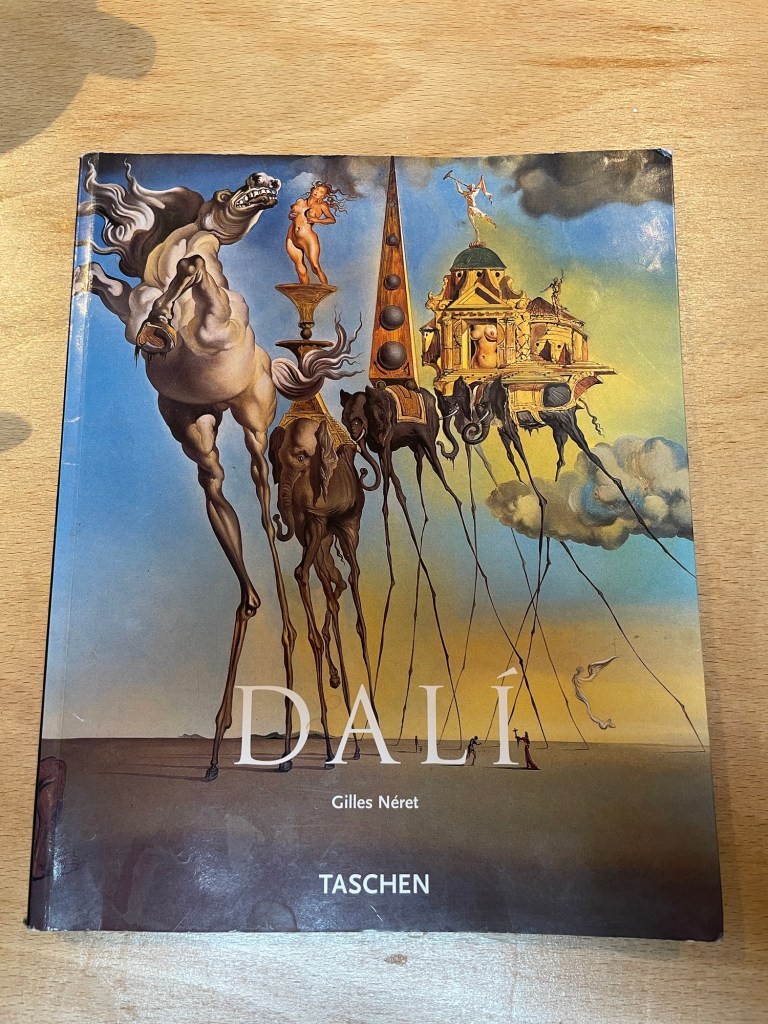
We spent some time reading about Dali’s very strange and often perturbing life and ideas and we agreed that for all his indisputable weirdness we are in awe of his technical skills and ability to lay his imagination so beautifully onto canvas.
One of my earliest awarenesses of being drawn to art was as a young child being impressed by a cousin’s surrealist paintings so it’s sort of interesting that George should pick Dali to copy. I think because I’ve always loved surrealism G has probably been influenced by my books and paintings by artists such as Leonora Carrington and Remedios Varo.
I used to think that much of Dali’s behaviour was to grab attention for his work but I think his work spoke for itself. I think he probably just couldn’t help himself and was a pretty unstable, anxious and paranoid individual with some pretty dodgey and distasteful views.
Do we need to like an artist to appreciate their work? It certainly makes it more difficult but I’m separating the two from here on and just talking about the artist in relation to his work.
For me his strengths as a painter lie in his ability to conjure an idea of epic scale and proportion. By placing small objects on the horizon as relevant and interesting to the composition as the large scale items in the foreground he creates a sense of pulling the viewer into a journey through and out the other side of a singular piece of canvas.
His paintings have a sense of epicosity about them echoing his “grandiose” sense of himself which I find very amusing and often wondered whether he did too. He was certainly witty but it’s impossible to know where that ends and his real views and ideas begin in earnest. I find Dali ambiguous and think that’s exactly what he intended. He achieves the viewer’s interest through both the mystery of his work and himself.
Anyhow I really enjoyed revisiting him again with George.
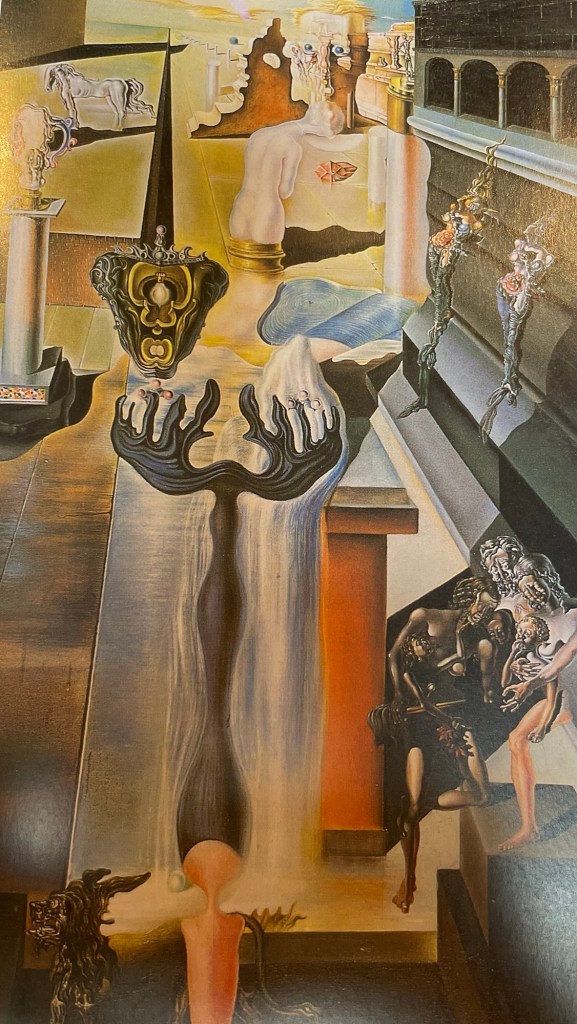
Above is a good example of Dali’s ability to create depth and scale.
We decided to lift a character from his painting titled: The Poetry of America – The Cosmic Athletes 1943
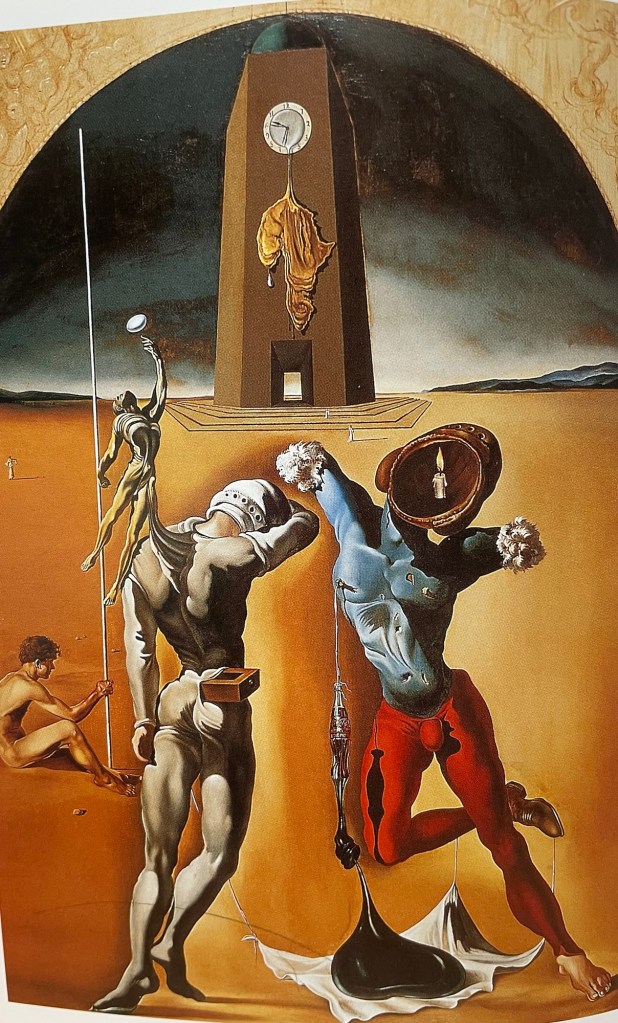
The figure we copied is in the middle ground and is effortlessly painted in the most complex of movements. One of Dali’s many skills is to paint physiques with such dynamicism.
The man is floating up into a vast landscape, he is leading with his outstretched fingers and ribcage. There is foreshortening of a leg, arm and head and all sorts of twisting of limb and torso.
We started trying to get rough shapes and outlines then after a few hours we were starting to get a credible likeness in parts. George was off out for the evening but I carried on with my first study which I’ve pictured below. I’ve also lifted an imposing looking tower out of the background as a reference to where the figure is floating. The building took no time at all but I learnt from copying the figure and it was good practice to sketch. I’m planning to change the colours from the original when I render it in oils and I’ll add some other objects of my own into the composition.

I recommend copying an artist you love as a means of coming to understand their compositions much better as well as improving drawing skills. Much meaning of a painting that can be easily missed by just glancing at it.
When you copy you look so much closer and in more depth. You see much more.
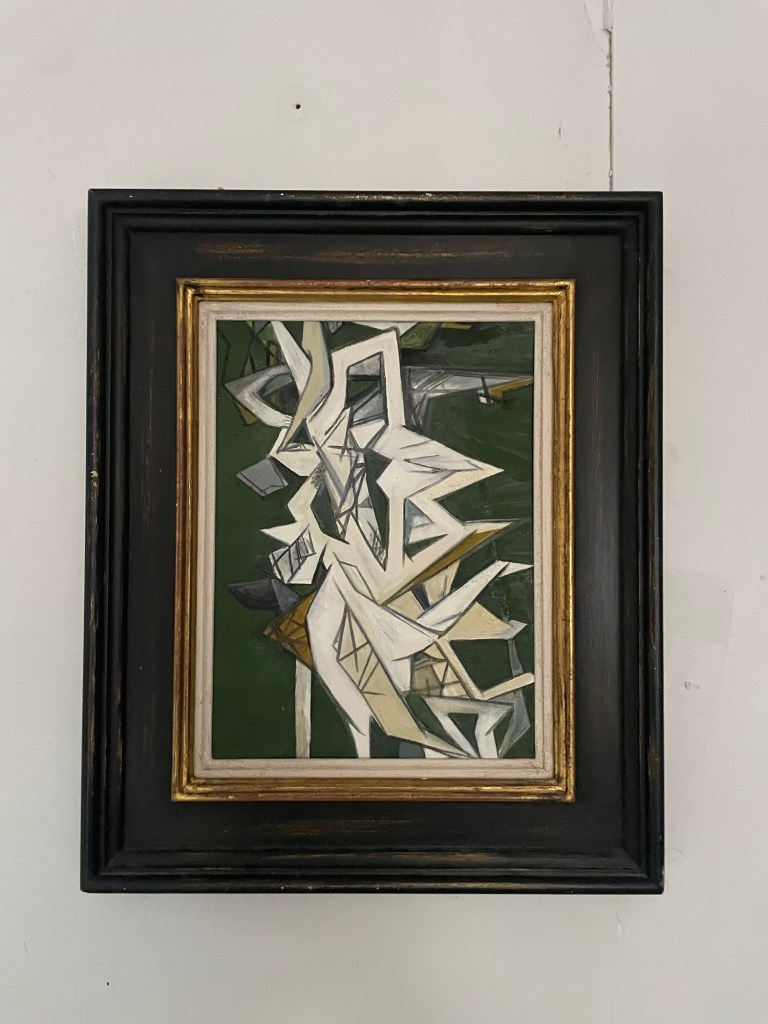
A picture I saw at Tate Modern by …. Is a good example of this. It’s an abstract and I didn’t realise until I copied it that it was anthropomorphic. I thought it was just geometric shapes! The copy is on a wall in my house and now all I see are the men in it and I wonder how I ever missed them when I came across it in the first place.
It’s been a while since George and I drew together. We’ve had GCSE’s then the start of a new sixth form eating into creative time for the last few years and what I noticed was that unlike before when he’d been constantly drawing for fun and had lots of time to practice without an imposing academic agenda he had become pretty rusty! Sorry George 😁.
So it’s not difficult to understand that art like anything needs time and practice to stay alive in us.
I also noticed that when George was younger he seemed to think and deliberate less on his artwork, it was more instinctive. Time and age can educate us away from instinctive creativity, it’s something we should be aware of and work to keep or regain. Once the shapes and drawings flowed, now he was not focusing properly on what he was seeing and copying, instead he began drawing legs as he knew them to be in his mind not from Dali’s picture. He’d managed to unlearn his practised skills! He drew both leg outlines in the same minute with a lot of pressure on the pencil before he knew he had them right.
I asked him to start again, this time when he got to the legs he needed to draw one as perfectly as he could then he could use it to reference the exact angle and size of the other.
When he found parts too complicated I asked him to see if drawing the outline of the negative space was easier, to forget he was drawing a leg completely in order to get away from what he thought he knew about its shape and just focus on replicating the lines in Dali’s image. This seemed to work for him and he started making breakthroughs.
It also helped to remind him that he needed to be completely comfortable in his posture for any tension in muscles will somehow translate to the page. I reminded him to relax his pencil grip and hold the pencil a little higher for more control and a better view of his work.
After a few hours his shapes were looking so much more convincing and he’d made up his lost years of practice.
None of us can expect to sit down and crack out work we’re instantly proud of. Where’s the fun in that?!!
The good news is that however rusty we’ve become in our drawing skills or whether we never had them in the first place, a little practice and a love of art is all we need to enjoy our creative time and establish a good level of skill.
I refuse to believe anyone when they say they are not creative. They are as creative as they want or make time to learn to be. The joy of art is waiting there for all of us if we can find a way to make time for it. I appreciate at certain points in our lives this can be difficult.
For me art is the biggest luxury I can think of so whenever I can I carve time out to practice it. I am always grateful when I have the time for it. I’d say I prefer making art and creating to mostly any experience I can think of. It brings me real happiness and contentment. This is one of my reasons for wanting to share our studios with others and encourage them into something so positive that can always be benefited from throughout life.
I’ll post our finished paintings from the Dali studies soon. Watch this space 🧐


Leave a comment